


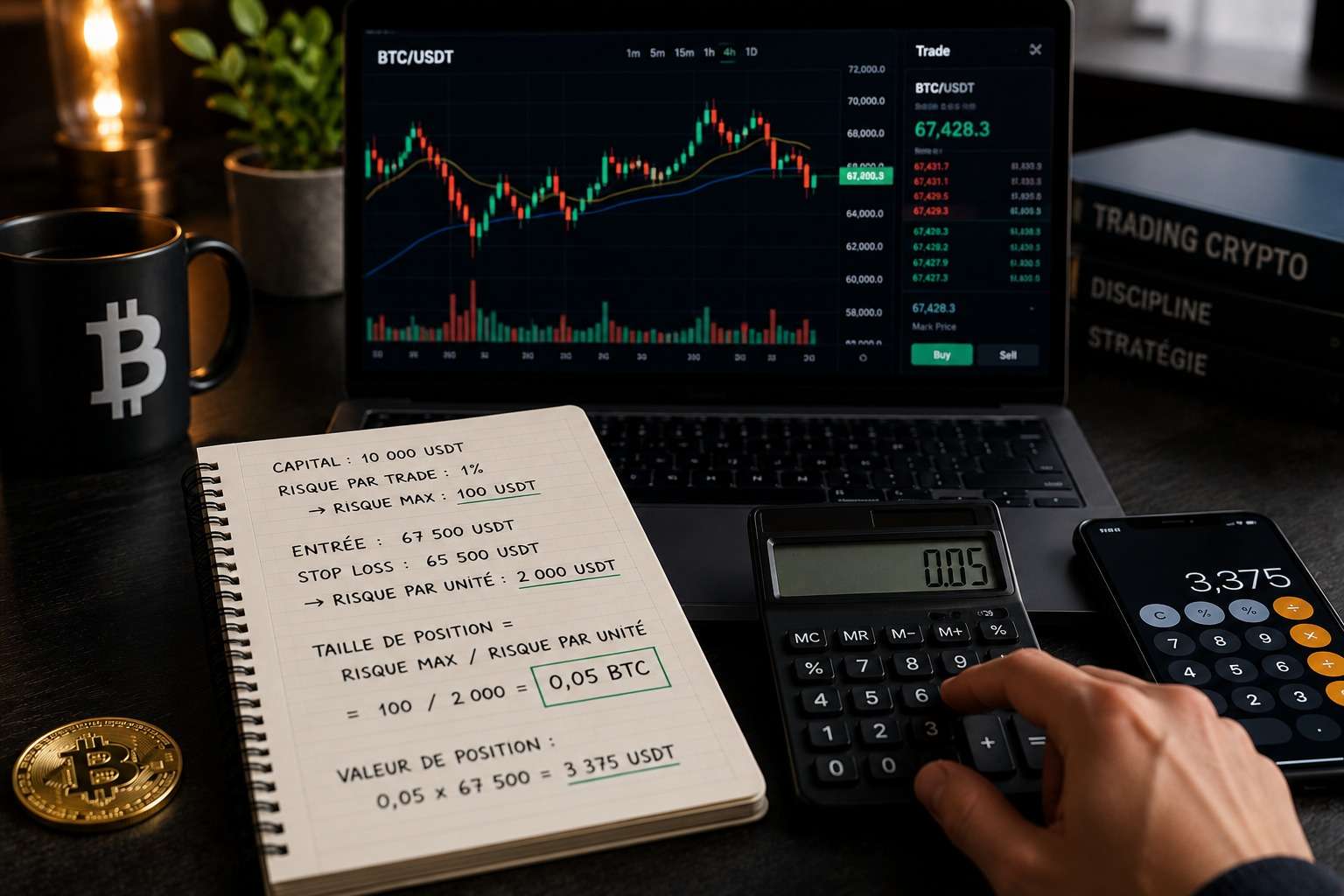
It’s one of the most overlooked skills among beginner traders, yet one of the most decisive for surviving the markets: knowing how to calculate your position size. Many focus on the question “when to buy?” while forgetting the far more important question “how much to commit?”. Yet it’s precisely position sizing that separates traders who last from those who empty their account in a few trades.
In this guide, we explain what position size is, why it’s crucial, and above all how to calculate it simply using a formula you can apply to every one of your trades.
What is position size?
Position size is simply the amount you commit to a given trade. For example, if you have 10,000 € in your account and decide to buy 2,000 € worth of Bitcoin, your position size is 2,000 €, or 20% of your capital.
The central question isn’t “how much can I gain?” but “how much can I afford to lose if this trade goes wrong?”. This is a fundamental shift in perspective. A good trader doesn’t size positions based on hopes of profit, but based on the risk they’re willing to take.
Why is position size so important?
Imagine two traders with the same 10,000 € capital and the same strategy. The first risks 50% of their capital on each trade. The second risks 1%. Even with a good strategy, the first can be ruined by a simple losing streak, which is statistically inevitable in trading. The second, on the other hand, can absorb dozens of consecutive losing trades without ever putting their account in danger.
This is the entire logic of risk management: staying in the game long enough for your statistical edge to materialize. A trader who blows up their account no longer has any chance of recovering, no matter how good their method. Position size is your main survival tool.
The key concept: risk per trade
The most widespread rule among professional traders is to never risk more than 1% to 2% of your capital on a single trade. This means that if the trade fails and your stop loss is hit, you only lose one or two percent of your total account.
With a risk of 1% per trade, it would theoretically take a series of many consecutive losses to seriously dent your capital, which leaves you a considerable safety margin. This is the foundation of a sustainable approach.
The formula to calculate your position size
Here is the universal formula, easy to remember and apply:
Position size = (Capital × Risk %) ÷ Stop loss distance
Let’s break down each element:
- Capital: the total amount of your trading account
- Risk %: the percentage of your capital you accept to lose on this trade (usually 1% or 2%)
- Stop loss distance: the gap between your entry price and your stop loss, expressed in the same unit as the price
These three pieces of information are enough to determine exactly how much to commit. Let’s see this with concrete examples.
Step-by-step concrete example
Let’s take a simple situation to illustrate the calculation.
Imagine the following data:
- Capital: 10,000 €
- Risk accepted per trade: 1%, or 100 €
- Entry price: 50 € per unit
- Stop loss placed at: 47 € per unit
First step, we calculate the stop loss distance: 50 € − 47 € = 3 € per unit. This is the loss you’ll suffer on each unit if the stop is hit.
Second step, we apply the formula: Position size = 100 € ÷ 3 € = 33.3 units.
So you buy about 33 units. Let’s verify: if the stop loss is hit, you lose 33 × 3 € = 99 €, which is precisely the 1% risk you had defined. The formula guarantees that your maximum loss matches exactly what you had decided in advance.
The central role of the stop loss in the calculation
You’ve noticed it: without a stop loss, the formula doesn’t work. This makes sense. If you don’t know where you exit in case of failure, you can’t calculate how much you risk, therefore how much to commit. The stop loss isn’t an option, it’s the starting point of all rational sizing.
This is also why the quality of your stop loss is decisive. A stop placed at random distorts the entire calculation. The ideal is to calibrate the stop to the asset’s actual volatility, via the ATR (Average True Range), rather than an arbitrary percentage. This approach is at the heart of SumoAnalysis’s TP/SL optimization, which provides a precise stop distance for each signal, directly usable in your position size calculation.
The hidden benefit: constant risk regardless of volatility
This method has a powerful benefit that many traders don’t realize. By calculating your position size from the stop loss, you maintain identical risk across all your trades, regardless of the asset’s volatility.
On a highly volatile asset, the stop loss will be wide (because normal fluctuations are large), so your position will automatically be smaller. On a calm asset, the stop will be tight, so your position will be larger. In both cases, your maximum loss stays the same: the percentage you set. You never overexpose your capital on dangerous assets, and you’re never too timid on stable ones.
This is exactly why precise stop levels matter so much. Combined with multi-timeframe analysis, they let you adjust your position in line with the timeframe and the real conditions of the market.
Mistakes to avoid in position sizing
A few traps come up systematically among traders who neglect this discipline:
- Trading without a stop loss: impossible to size correctly, and unlimited exposure in case of a reversal
- Increasing size after a loss to “recover”: this is the martingale, the fastest path to ruin
- Risking too high a percentage out of overconfidence on a “sure” trade: no trade is sure
- Ignoring correlation: opening five positions on cryptos that move together is like taking a single position five times bigger
- Adapting the stop to the position rather than the position to the stop: this is the opposite of the right method
Integrating sizing into a complete method
Position sizing isn’t an isolated gesture: it fits into a global approach to trading. A good trade rests on three pillars: solid analysis to identify the opportunity, a well-placed stop loss to define the risk, and rigorous sizing to protect capital.
This is the complete logic that SumoAnalysis structures. The AI-powered crypto technical analysis identifies high-probability setups, each crypto signal provides a precise stop loss and targets, and all you have to do is apply the position size formula to commit the right amount. The final decision and execution remain entirely in your hands.
Summary
- Position size determines how much you commit on each trade, and it’s your main survival tool
- The basic rule: never risk more than 1% to 2% of your capital per trade
- The formula: Position size = (Capital × Risk %) ÷ Stop loss distance
- Without a stop loss, no rational sizing is possible
- This method guarantees constant risk regardless of the asset’s volatility
- Mistakes to avoid: trading without a stop, increasing size after a loss, risking too much on a “sure” trade
- Sizing fits into a complete method: analysis, stop loss, position size
👉 Try SumoAnalysis free for 7 days and receive signals with precise stop levels, to easily calculate the ideal position size on every trade.
Disclaimer: This article is for educational purposes and does not constitute investment advice. Cryptocurrency trading carries a risk of capital loss. Only trade with capital you can afford to lose.