


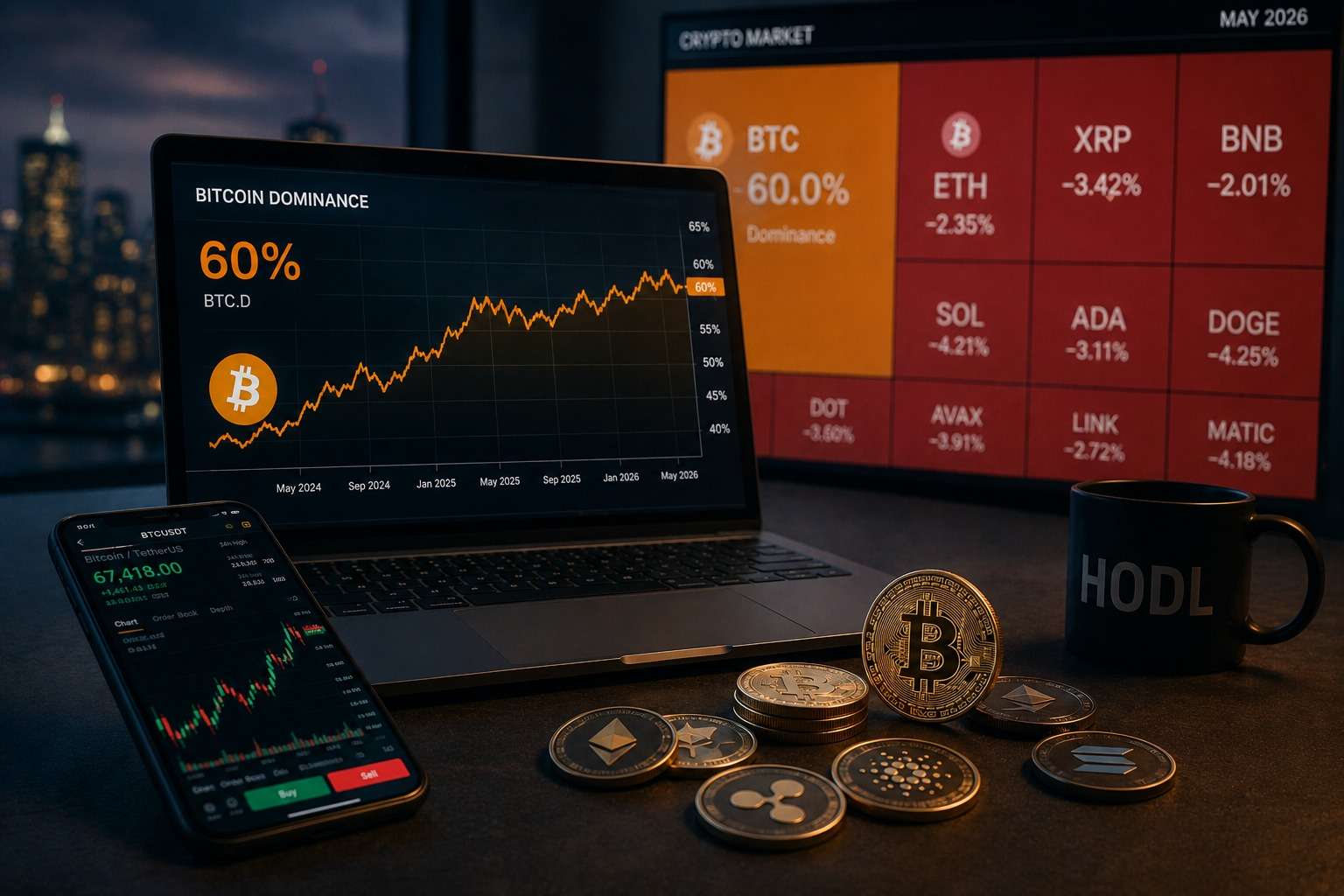
In May 2026, Bitcoin’s share of the total crypto market capitalization reached 60.3%. The Altcoin Season Index stands at 35—right in the middle of “Bitcoin Season.” This means that only about one-third of the top 50 cryptocurrencies have outperformed Bitcoin over the past 90 days. For altcoin traders, this is a frustrating period: the technical setups look good, but the price movements aren’t following through.
In this article, we analyze why the rotation toward altcoins isn’t happening, the concrete signals to watch for to anticipate the shift, and how to adapt your strategy in the meantime.
What Is Bitcoin Dominance and Why It Matters
Bitcoin dominance (BTC.D) measures BTC’s share of the total crypto market capitalization. When BTC.D rises, it means money is flowing into Bitcoin faster than into the rest of the market. When BTC.D falls, capital diversifies into altcoins—this is the famous “altseason.”
In May 2026, BTC.D is hovering around 60%, a level it hasn’t reached since late 2023. This is a clear signal: investors, and particularly institutions, are overwhelmingly favoring Bitcoin over altcoins.
Why Institutions Are Staying with Bitcoin
Massive Institutional Accumulation
Institutional flows in 2026 are almost exclusively directed toward Bitcoin:
- Strategy (formerly MicroStrategy) holds 818,869 BTC for a total of nearly $62 billion, with a BTC return of 9.4% year-to-date
- Abu Dhabi’s sovereign wealth fund increased its BTC holdings in the first quarter
- Italy’s largest bank doubled its crypto assets to $235 million in Q1, adding ETH and XRP for the first time
- BlackRock is considering a $5–10 billion stake in SpaceX’s IPO, signaling institutional appetite for tech/crypto assets
Notable exception: Bitmine Immersion Technologies has accumulated 5.2 million ETH (4.31% of the circulating supply), becoming the world’s largest corporate Ethereum holding. But this is the exception, not the rule.
Why institutions prefer Bitcoin
- Bitcoin ETFs are more liquid and better established than altcoin ETFs
- Bitcoin is perceived as “digital gold”—a simple narrative that investment committees understand
- Bitcoin’s risk profile is lower than that of altcoins (lower relative volatility)
- The uncertain macro environment (6% inflation) is driving institutions toward “quality” within the crypto asset class
In summary: when the market is in risk-off mode, smart money focuses on Bitcoin and shuns altcoins.
The Altcoin Season Index: how to read it
The Altcoin Season Index from blockchaincenter.net measures how many of the 50 largest cryptocurrencies (excluding stablecoins and asset-backed tokens) have outperformed Bitcoin over the past 90 days.
- Above 75: altseason confirmed (altcoins are massively outperforming BTC)
- Below 25: Bitcoin season (BTC clearly dominates)
- Between 25 and 75: neutral zone, no clear trend
At 35 in May 2026, we are in the lower half of the neutral zone, close to Bitcoin Season. During previous altseason peaks (2017, 2021), the index exceeded 90. We are very far from that.
The 4 technical signals to watch for the rotation
The rotation toward altcoins does not happen randomly. It is always accompanied by measurable signals on the charts:
Signal 1: BTC.D falls below 59.63%
The 59.63% level corresponds to the long-term 0.236 Fibonacci retracement. This is the first major support level. A confirmed break below this level (with a weekly close below it) would signal the start of a rotation of capital toward altcoins.
Signal 2: The ETH/BTC ratio stabilizes or rebounds
The ETH/BTC ratio has been falling for several months (4 consecutive declines). A reversal of this ratio is often the first sign that capital is beginning to shift toward altcoins, starting with Ethereum.
Signal 3: The Altcoin Season Index exceeds 50
The 50 threshold is the pivot point. Above it, most major altcoins outperform Bitcoin, creating a virtuous cycle of attention and capital flows.
Signal 4: Altcoin volume increases independently of BTC
When altcoins rise with increasing volume while Bitcoin is stable or slightly up, it’s a sign that fresh capital is flowing into altcoins (and not just recycled capital from BTC).
How to Trade During Bitcoin Dominance
The Temptation During Bitcoin Season
Many traders, frustrated by the underperformance of altcoins, make two mistakes: they persist in trading altcoins that aren’t moving by making numerous trades with little conviction, or they increase leverage on altcoins to “compensate” for modest movements. Both approaches are destructive to your capital. If the market tells you it’s Bitcoin Season, don’t fight it.
The Right Approach
Focus on Bitcoin and Ethereum. These are the two assets that offer the best liquidity, the most predictable price movements, and the narrowest spreads. Trading BTC on the 4-hour and daily timeframes during Bitcoin Season is often more profitable than chasing moves across 20 different altcoins.
If you still want to trade altcoins, select only those that have actually outperformed Bitcoin over the last 30 days. In May 2026, a few altcoins are holding up better than the rest of the market, particularly those backed by real revenue (protocol fees, on-chain volumes). But they remain the exception.
Altcoins holding up in May 2026: what sets them apart?
The few altcoins maintaining valuations close to their all-time highs share an important commonality: they generate real revenue or significant on-chain activity volumes. This is no coincidence as the market distinguishes between speculation and utility.
Projects backed by real-world activity (stablecoins, decentralized exchanges, revenue-generating DeFi protocols) tend to hold up better during market downturns than purely speculative tokens. This is a factor to consider when selecting pairs to trade.
Multi-timeframe analysis to navigate dominance
Multi-timeframe analysis is particularly useful during periods of Bitcoin dominance because it helps you:
- Identify the underlying trend of BTC.D on the 1W and 1D charts before deciding whether to trade BTC or altcoins
- Filter out false breakouts on altcoins by verifying consistency with the higher timeframe
- Time the rare altcoin moves that work by ensuring they align with the overall direction
A 15-minute altcoin signal that goes against the 4-hour BTC trend is a recipe for losing money. This is even more true during Bitcoin Season, when altcoins tend to correct more sharply than BTC.
When will the rotation occur?
No one can predict the exact timing. But previous cycles offer some guidance:
- In 2017 and 2021, the rotation toward altcoins occurred when Bitcoin had set a new all-time high and its price stabilized for several weeks
- The rotation typically begins 4 to 8 weeks after BTC peaks, when investors seek higher returns and turn to “lagging” altcoins
- The catalyst is often an event that reduces macro uncertainty (falling inflation, lower interest rates, regulatory clarity)
In May 2026, with inflation at 6% and a new Fed chair, macro uncertainty remains high. As long as this uncertainty persists, it is unlikely that the rotation will take hold in a sustainable manner.
How SumoAnalysis helps you navigate dominance
The SumoAnalysis crypto software covers over 1,500 crypto pairs, but the crypto signals it generates are weighted by confidence and market context. During Bitcoin Season, BTC/USDT and ETH/USDT signals naturally tend to have higher confidence scores than altcoin signals, guiding you toward the best opportunities without spreading yourself too thin.
Crypto technical analysis automatically checks the multi-timeframe consistency of each signal, filtering out altcoin setups that go against the underlying trend.
In summary
- Bitcoin dominance at 60% in May 2026 reflects institutional flows heavily weighted toward BTC
- The Altcoin Season Index at 35 confirms that the rotation toward altcoins has not yet begun
- Signals to watch: BTC.D below 59.63%, ETH/BTC ratio rebounding, Altcoin Season Index above 50
- While waiting for the rotation, focus on BTC and ETH rather than chasing altcoins
- The altcoins holding up are those backed by real revenue and on-chain volumes
- The rotation will likely occur when macro uncertainty subsides (lower inflation, Fed clarity)
- Don’t increase leverage on altcoins to compensate for their underperformance—that’s the classic trap
👉 Try SumoAnalysis free for 7 days and receive market-context-weighted signals to trade only the best opportunities.
Disclaimer: This article is a market analysis for educational purposes. It does not constitute investment advice. Past performance is not indicative of future results.