


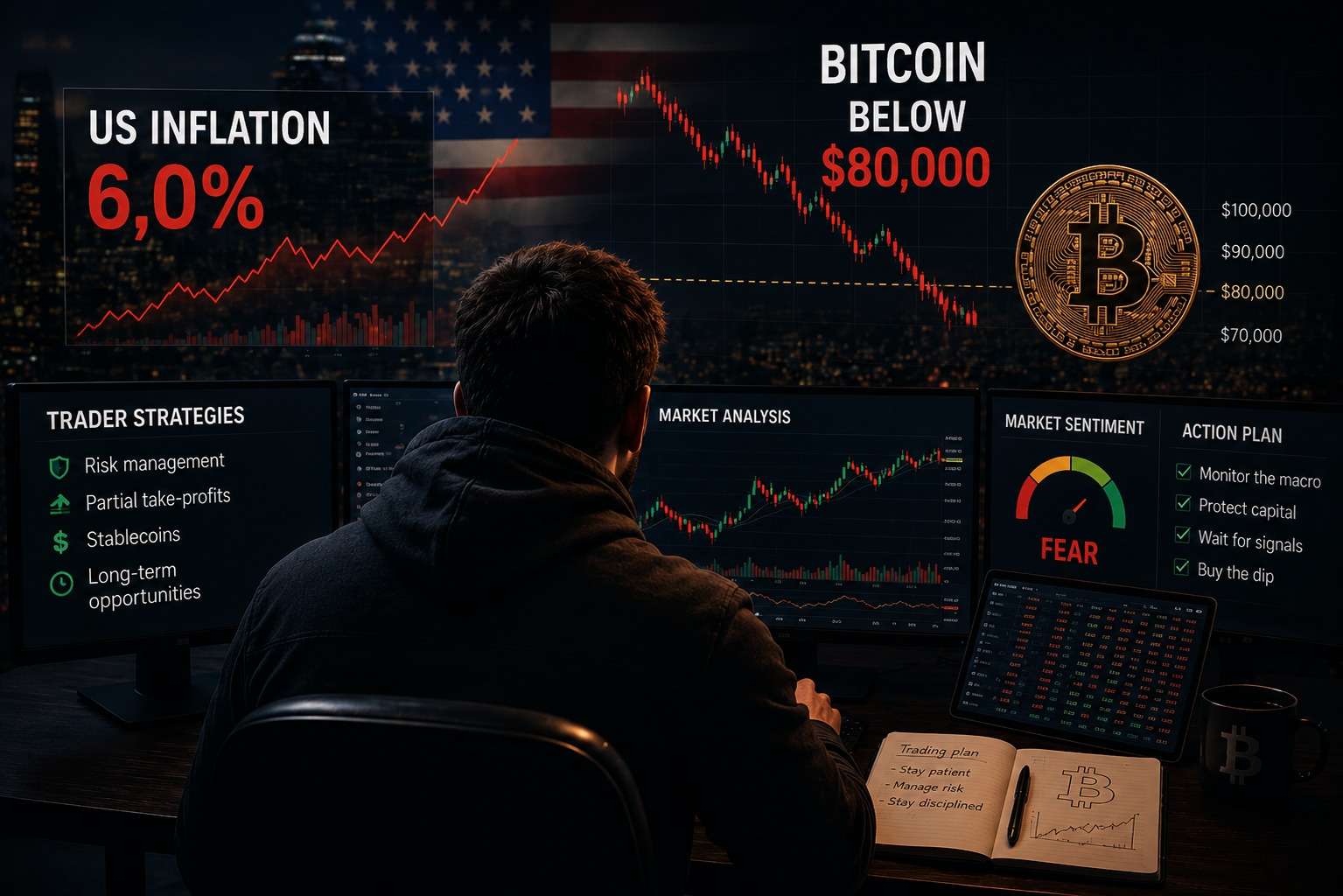
U.S. inflation reached 6% in April 2026, its highest level since December 2022. Bitcoin reacted immediately by dropping below $80,000, dragging the entire crypto market into a 5% to 10% correction within a few days. For crypto traders, this macroeconomic shock temporarily changes the rules of the game—and those who fail to adapt risk being crushed by volatility.
In this article, we analyze what this inflation actually means for the crypto market, why Bitcoin fell even though it’s supposed to be a hedge against inflation, and how to adjust your trading strategy to navigate this environment.
Why the 6% PPI caused Bitcoin to plummet
What happened
On May 13, 2026, the Bureau of Labor Statistics released the Producer Price Index (PPI) for April. The monthly increase of 1.4% far exceeded the consensus estimate of 0.5%, and the annual rate jumped to 6%, well above the 4.9% expected by the market.
Within hours, Bitcoin fell from $81,000 to around $79,500, breaking through the psychological $80,000 threshold. Tech stocks followed suit (S&P 500 down 1.24%, Nasdaq down 1.54%), bond yields climbed, and the dollar strengthened.
The Transmission Mechanism
Contrary to what many beginners believe, Bitcoin does not automatically rise when inflation increases. In the short term, the opposite is often true. Here’s why:
- High inflation means the Fed keeps interest rates high for longer, or even raises them
- High rates increase the opportunity cost of holding Bitcoin (which pays no interest), making bonds and savings accounts more attractive
- High rates reduce overall market liquidity, which puts pressure on risky assets like cryptocurrencies
- The dollar strengthens, which automatically weighs on dollar-denominated prices
In the long term (several years), Bitcoin can indeed serve as a hedge against currency devaluation. But in the short term (days to weeks), it behaves like a risky asset correlated with tech stocks.
Change at the helm of the Fed: Kevin Warsh replaces Powell
On May 15, 2026, Jerome Powell’s term as Chair of the Federal Reserve came to an end. Kevin Warsh, confirmed by the Senate, succeeds him.
This change is significant for the crypto markets. Warsh has described Bitcoin as “an important asset” and “a very good policeman of monetary policy”—remarks that are significantly more positive than those of Powell. However, he inherits a 6% inflation rate that leaves him very little room to ease monetary policy in the short term.
The paradox: the new chair is potentially more crypto-friendly, but the macroeconomic context forces him to maintain restrictive monetary conditions that weigh on prices. Traders must therefore monitor his initial statements and monetary policy decisions to gauge the direction.
What this means for your trading
Adjust your risk management
During periods of high inflation and macroeconomic uncertainty, volatility increases. Price movements are more extreme, and false signals are more frequent. In practical terms, this means:
- Reduce the size of your positions. If you typically risk 2% per trade, temporarily switch to 1% or 1.5%
- Widen your stops. The ATR (Average True Range) increases during volatile periods, so your stops must follow suit. A stop that is too tight in this environment will be triggered by normal market noise
- Reduce the number of open positions simultaneously. A maximum of 2–3 positions instead of 4–5
- Keep more cash on hand (30–40% of the portfolio) to take advantage of buying opportunities after sharp corrections
ATR-based TP/SL optimization is particularly useful in this context: it automatically adjusts the stop distance based on measured volatility, protecting you without forcing you out prematurely.
Prioritize longer timeframes
During periods of macroeconomic uncertainty, short timeframes (5-min, 15-min) become extremely noisy. Movements linked to economic data releases (PPI, CPI, Fed decisions) create violent spikes that trap scalpers.
Prioritize the 4H and 1D timeframes for your main decisions. Multi-timeframe analysis is even more crucial in this environment: a 15-minute signal against the 1D trend has an even lower probability of success than usual.
Monitor the economic calendar
The following macroeconomic releases will strongly influence Bitcoin’s price in the coming weeks:
- Fed minutes (May 20): these will reveal the committee’s internal tone and inflation projections
- May CPI (mid-June): if inflation continues to accelerate, expect another correction
- Warsh’s first decisions: his first press conference will set the tone for his chairmanship
Practical tip: do not take any positions 30 minutes before and 1 hour after these releases. Initial volatility is often misleading—the “real” moves emerge after the market has digested the information.
Bitcoin as an inflation hedge: myth or reality?
The long-term thesis remains intact
Over horizons of 4+ years, Bitcoin has historically outperformed inflation. Its fixed supply of 21 million BTC structurally protects it against monetary devaluation, unlike fiat currencies that can be printed in unlimited quantities.
Institutional investors seem to share this conviction. In May 2026, Abu Dhabi’s sovereign wealth fund increased its BTC holdings, Italy’s largest bank doubled its crypto assets to $235 million in the first quarter, and Strategy (formerly MicroStrategy) now holds 818,869 BTC for a total of nearly $62 billion.
But the short term is a different story
In May 2026, BTC is behaving like a risky asset, not like digital gold. It follows stock market indices lower when inflation surprises. The Crypto Fear & Greed Index has fallen to 28 (the “extreme fear” zone), reflecting very negative market sentiment.
For active traders, this distinction is essential. Don’t hold a long position in BTC thinking, “It’s a hedge against inflation, so it’ll bounce back.” In the short term, liquidity flows and sentiment largely dominate fundamentals.
Opportunities Hidden in the Correction
Corrections linked to macro shocks aren’t just threats. They also create opportunities for disciplined traders:
- Macro oversold conditions offer low-price entry points for those with available cash
- RSI divergences are often more pronounced after a shock (the price hits a new low but the RSI doesn’t follow)
- The cascading liquidations that accompany these moves leave “liquidity gaps” that the price often returns to fill
The crypto signals issued by SumoAnalysis incorporate these market conditions into their calculations: the confidence score decreases during periods of high macro uncertainty, helping you to take only high-probability setups.
How SumoAnalysis adapts to the macro environment
The SumoAnalysis crypto software continuously analyzes volatility and momentum across 5 timeframes simultaneously. During periods of macro shock like that of May 2026, several automatic adjustments occur:
- Stops are widened based on the increased ATR
- Low-confidence signals are filtered out more aggressively
- Crypto technical analysis accounts for the disrupted market structure to avoid the false breakouts typical of panic phases
These automatic adjustments save you from having to manually recalibrate your approach with every macro release—which is exactly when most traders make emotional mistakes.
In summary
- US inflation at 6% sent Bitcoin below $80,000, dashing expectations of rate cuts
- In the short term, Bitcoin is behaving like a risky asset, not an inflation hedge
- Kevin Warsh, the new Fed chair, is more crypto-friendly but constrained by inflation
- Adjust your risk management: reduce position sizes, widen stops, keep cash on hand
- Focus on long timeframes (4H, 1D) during periods of macro uncertainty
- Avoid trading around economic data releases (CPI, PPI, Fed minutes)
- Macro corrections create buying opportunities for disciplined traders
👉 Try SumoAnalysis free for 7 days and receive signals with risk management that automatically adapts to market conditions.
Disclaimer: This article is a market analysis for educational purposes. It does not constitute investment advice. Cryptocurrency trading involves the risk of capital loss. Only trade with capital you can afford to lose.