

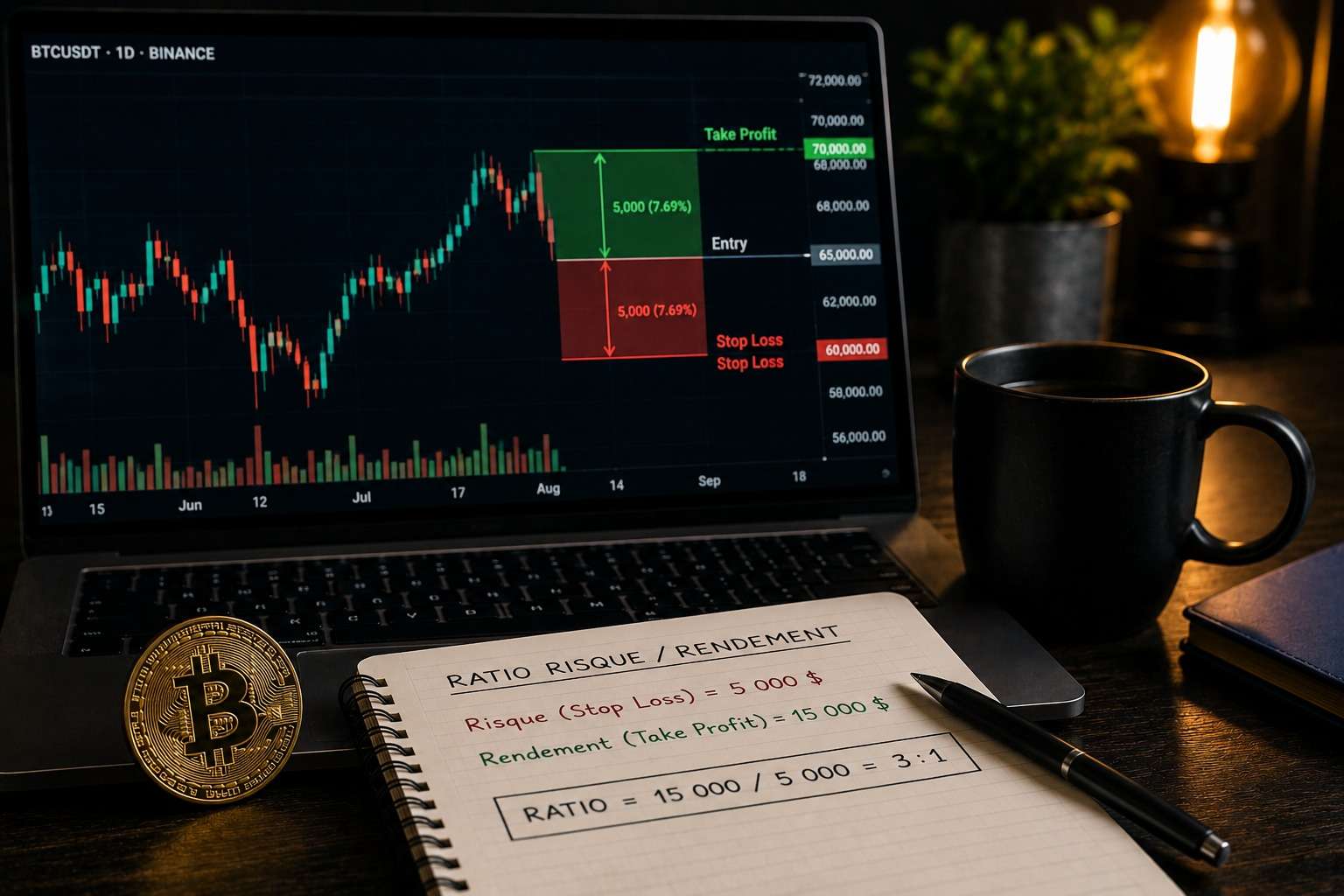
Here’s one of the most counterintuitive ideas in trading: you can lose the majority of your trades and still be profitable overall. The secret lies in a simple but fundamental concept, the risk/reward ratio. Properly understood and applied, it completely changes how you approach the markets, because it shifts your focus from “being right” to “making money”, which are not at all the same thing.
In this guide, we explain what the risk/reward ratio is, how to calculate it, and why it matters far more than your win rate.
What is the risk/reward ratio?
The risk/reward ratio (often written R/R) compares two things on a single trade: what you risk losing, and what you hope to gain. Concretely, it’s the distance between your entry price and your stop loss (the risk), compared to the distance between your entry price and your profit target (the reward).
Let’s take a simple example. You buy a crypto at 100 €. You place your stop loss at 90 €, so you risk 10 € per unit. You aim for a target at 130 €, so you hope to gain 30 € per unit. Your risk/reward ratio is 10 to 30, which simplifies to 1 to 3, or 1:3. In other words, you risk 1 to potentially gain 3.
How to calculate your risk/reward ratio
The calculation is done in two steps, very simply.
First, you measure your risk: the difference between your entry price and your stop loss. Then, you measure your potential reward: the difference between your entry price and your profit target. Finally, you compare the two.
R/R ratio = Potential reward ÷ Risk
Let’s use concrete numbers. Entry at 50 €, stop loss at 45 €, target at 65 €. The risk is 50 − 45 = 5 €. The reward is 65 − 50 = 15 €. The ratio is therefore 15 ÷ 5 = 3, or a ratio of 1:3. You risk 1 to aim for 3.
The higher the second number, the more attractive the trade from a risk/reward standpoint. A ratio of 1:3 is generally considered good, a ratio of 1:1 mediocre, and a ratio below 1:1 (where you risk more than you aim for) something to avoid in most cases.
Why this ratio matters more than your win rate
This is where the concept becomes powerful. Many beginner traders are obsessed with their win rate, meaning the percentage of winning trades. They think you have to win the majority of your trades to be profitable. This is false, and the risk/reward ratio explains why.
Imagine you always trade with a 1:3 ratio, risking 100 € to aim for 300 €. Let’s do the math over 10 trades, assuming you only win 4 out of 10 (a win rate of just 40%):
- 4 winning trades × 300 € = 1,200 € in gains
- 6 losing trades × 100 € = 600 € in losses
- Net result: 1,200 − 600 = 600 € in profit
You lost 60% of your trades, and yet you’re solidly profitable. That’s the whole magic of a good risk/reward ratio: it lets you be profitable even with a low win rate, because your gains largely cover your losses.
The reverse is also true
On the opposite end, a bad ratio can make you a loser even with an excellent win rate. Imagine you risk 300 € to aim for only 100 € (a ratio of 3:1, very unfavorable). Even winning 7 trades out of 10:
- 7 winning trades × 100 € = 700 € in gains
- 3 losing trades × 300 € = 900 € in losses
- Net result: 700 − 900 = 200 € in loss
You win 70% of your trades and still lose money. The lesson is clear: the risk/reward ratio and the win rate work together, but a good ratio forgives a bad win rate, whereas a good win rate doesn’t save a bad ratio.
The break-even threshold by ratio
Each risk/reward ratio corresponds to a minimum win rate to be profitable. It’s a valuable benchmark for knowing whether your strategy holds up. Here are the most useful thresholds to know:
- With a 1:1 ratio, you need to win more than 50% of your trades to be profitable
- With a 1:2 ratio, you only need to win more than 33% of your trades
- With a 1:3 ratio, you only need to win more than 25% of your trades
In other words, the more favorable your ratio, the less often you need to be “right”. This is what allows professional traders to stay calm even after a losing streak: they know their ratio does the work over time.
How to apply the risk/reward ratio in practice
The golden rule is simple: before entering a trade, check that the ratio is favorable. If the profit potential isn’t at least two to three times greater than the risk, the trade often isn’t worth taking.
Concretely, this requires three things. First, identify a realistic profit target, based on technical levels (a resistance, a previous high), not on a wish. Then, place a coherent stop loss, calibrated to the asset’s actual volatility. Finally, compare the two distances before validating the entry.
If the ratio is bad, two options: either you wait for a better entry point that brings your stop closer, or you skip it. Never forcing a trade with an unfavorable ratio is one of the hallmarks of disciplined traders.
The risk/reward ratio at the heart of SumoAnalysis
Manually calculating the ratio of each trade takes time and rigor. This is precisely what SumoAnalysis automates. Each crypto signal provides an entry point, a stop loss and profit targets, letting you instantly visualize the trade’s risk/reward ratio.
Thanks to TP/SL optimization, the levels are calibrated to actual volatility via the ATR, ensuring coherent ratios rather than arbitrary targets. And since the ratio depends on the timeframe, multi-timeframe analysis adapts the levels to your trading horizon. The AI-powered crypto technical analysis only keeps setups offering an attractive risk/reward, filtering out those that aren’t worth it.
Summary
- The risk/reward ratio compares what you risk to what you hope to gain on a trade
- It’s calculated as: Potential reward ÷ Risk (a ratio of 1:3 is considered good)
- A good ratio makes you profitable even with a low win rate
- A bad ratio makes you a loser even with an excellent win rate
- Benchmarks: 1:2 profitable from 33% win rate, 1:3 profitable from 25% win rate
- The golden rule: only take trades whose potential is at least 2 to 3 times the risk
- Never force a trade with an unfavorable ratio
👉 Try SumoAnalysis free for 7 days and receive signals with entry, stop and targets, to evaluate the risk/reward ratio of every trade at a glance.
Disclaimer: This article is for educational purposes and does not constitute investment advice. Cryptocurrency trading carries a risk of capital loss. Only trade with capital you can afford to lose.