


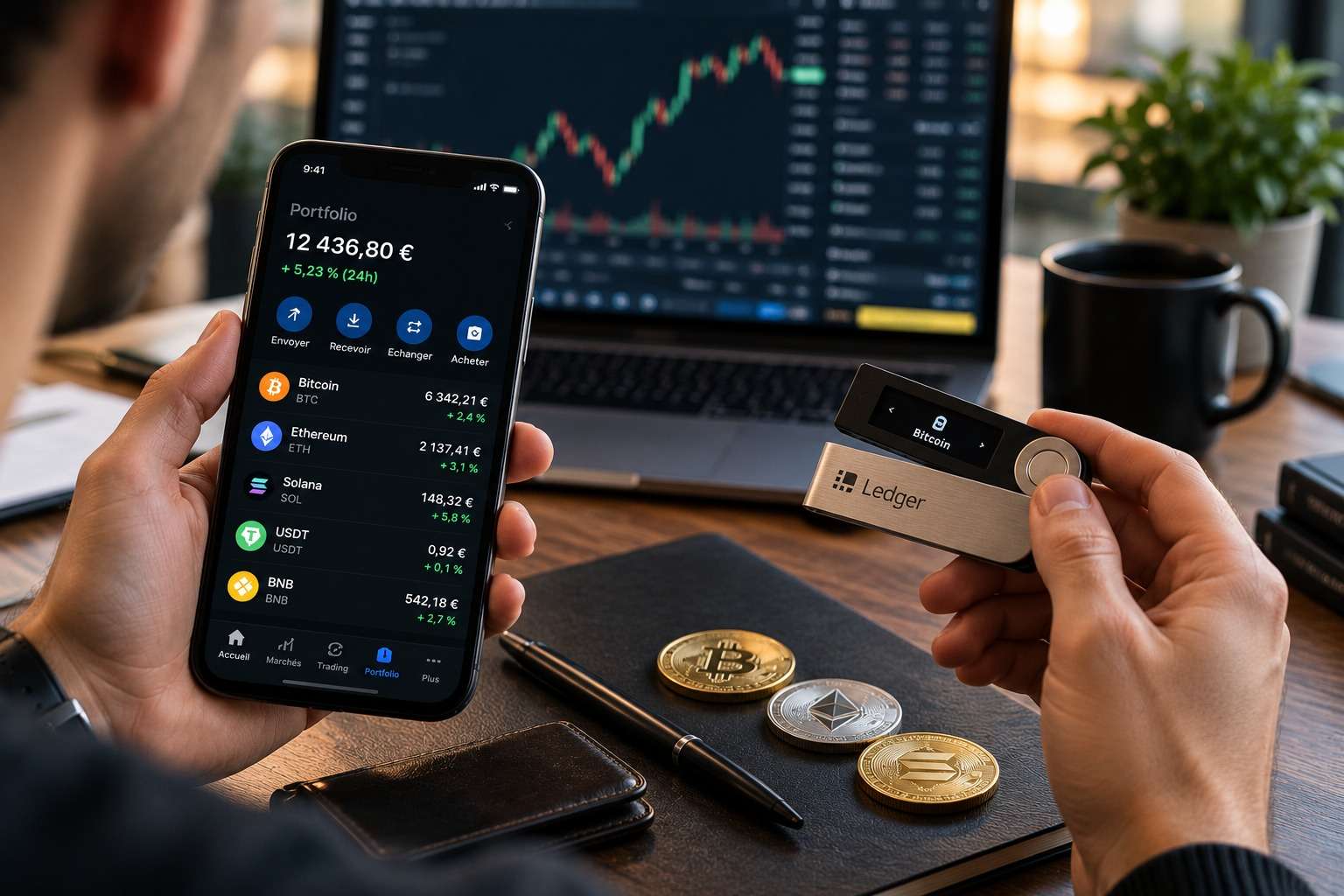
You’ve just bought your first cryptocurrencies, and a crucial question arises: where do you store them safely? Between the hot wallet, convenient but connected to the internet, and the cold wallet, offline and highly secure, the choice is not trivial. It can make the difference between well-protected funds and a nasty surprise. In this guide, we explain the difference between these two types of wallets, their benefits and their risks, to help you secure your crypto based on your usage.
Before getting into the detail, a useful reminder: a crypto wallet doesn’t contain your crypto itself, but the keys that prove you own it. To fully understand this fundamental point, see our guide on the crypto wallet.
Reminder: what is a wallet and what are the keys for?
A wallet is the tool that lets you store, send and receive cryptocurrencies. Your crypto actually exists on the blockchain. The wallet itself holds your cryptographic keys.
There are two keys to distinguish. The public key is like an address or account number: you share it to receive funds, with no risk. The private key is the ultimate key: it alone authorizes sending funds. The golden rule is simple: whoever holds the private key controls the funds. The entire question of security revolves around protecting that private key, and that’s exactly where the hot/cold distinction takes on its full meaning.
The hot wallet: convenient but connected
A hot wallet is a wallet connected to the internet. It can take the form of a mobile app, a browser extension, or the wallet built into an exchange platform such as Binance or Coinbase.
Its advantages
The hot wallet shines through its convenience. Access is fast, transactions are instant, and it’s ideal for active trading or frequent payments. For a trader who needs to react quickly to market moves, it’s the natural tool. Most are free and easy to get started with, which makes them the entry point for beginners.
Its risks
Its strength is also its weakness: the permanent connection to the internet exposes it more to hacking, phishing and malware. If a hacker gains access to your device or your credentials, your funds can be stolen. That’s why the hot wallet is not recommended for storing large sums over the long term. It’s reserved for the amounts you actively use.
The cold wallet: maximum security
A cold wallet is an offline wallet, most often in the form of a physical device (hardware wallet) resembling a USB stick, such as Ledger or Trezor models. There are also paper cold wallets, but physical devices are the most common.
Its advantages
The cold wallet offers maximum security. Your private keys are never exposed to the internet: they stay stored inside the device, out of reach of hackers. Even if you plug the hardware wallet into an infected computer, the keys never leave the device, and each transaction must be physically validated on the unit. It’s the recommended solution for keeping crypto savings over the long term.
Its drawbacks
The trade-off is reduced convenience. Accessing your funds requires plugging in the device and validating manually, which isn’t ideal for daily trading. The hardware wallet also costs money (a few tens of euros). Finally, you must absolutely back up the recovery phrase (seed phrase) in a safe place: if you lose both the device AND the phrase, your funds are lost forever.
Hot or cold: how to choose?
The right choice depends on your usage and the amounts involved:
- For actively trading modest amounts: a hot wallet or your exchange’s wallet, for execution speed.
- For keeping crypto savings over the long term: a cold wallet, for maximum security.
- For most users: a combination of both. Keep a small amount in a hot wallet for everyday use, and secure the bulk of your holdings in a cold wallet.
This mixed approach is the one used by savvy users. It combines the best of both worlds: responsiveness for trading, security for saving.
The golden rule: “not your keys, not your coins”
One principle sums up the whole philosophy of crypto security: “not your keys, not your coins”. Leaving all your funds on an exchange platform means entrusting your private keys to a third party. If the platform goes bankrupt, gets hacked or freezes withdrawals, you lose access to your funds.
Holding your own keys in a personal wallet, hot or cold, means keeping full control. The history of crypto is littered with platform failures where users lost everything for failing to secure their funds themselves. It’s a lesson to remember from the start.
Wallet and trading: the right balance
To trade, your crypto generally needs to be on an exchange platform, in a connected wallet. This is normal and necessary to execute your orders quickly. The best practice is to keep only the funds you actively trade on the platform, and to secure the rest on a cold wallet.
Once your funds are in place, the key to successful trading isn’t the wallet itself, but the method. That’s where SumoAnalysis comes in. AI-powered crypto technical analysis identifies high-probability opportunities, and each crypto signal comes with a complete plan: entry, stop and targets, calibrated by TP/SL optimization. You then execute these signals from the platform of your choice, while keeping control over the security of your funds.
Summary
- A wallet stores the keys that give access to your crypto, not the crypto itself
- The hot wallet is connected to the internet: convenient for trading, but more exposed to hacking
- The cold wallet is offline: maximum security, ideal for long-term savings
- The best approach combines both: a small amount in hot, the bulk in cold
- “Not your keys, not your coins”: holding your own keys means keeping control
- For trading, keep only the actively used funds on the platform
👉 Try SumoAnalysis free for 7 days and receive structured signals to execute from the secure platform of your choice.
Disclaimer: This article is for educational purposes and does not constitute investment advice. Cryptocurrency trading carries a risk of capital loss. Only trade with capital you can afford to lose.