


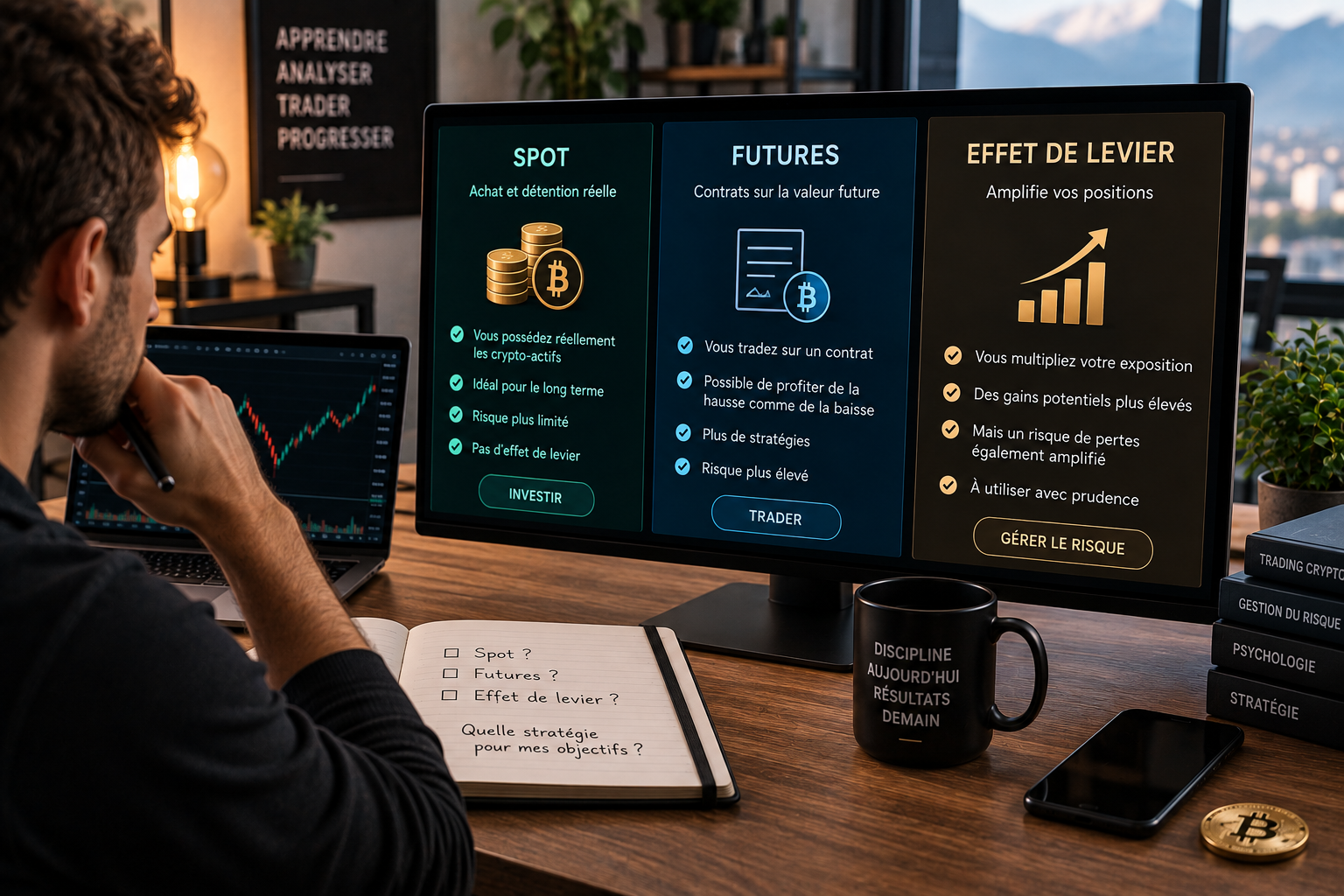
Before even choosing a strategy or an indicator, every crypto beginner must understand a fundamental distinction: the way they trade. Buying Bitcoin directly, betting on its price through futures contracts, or amplifying your positions with leverage are three radically different approaches, with risk levels that have nothing to do with each other. Confusing these concepts, or diving into leverage without measuring the consequences, is one of the beginner’s most costly mistakes.
In this guide, we clearly explain what spot trading, futures and leverage are, their differences and which to choose based on your profile.
Spot trading: actually buying and holding
Spot trading is the simplest and most direct form of crypto trading. When you buy on the spot market, you actually buy the asset and you own it. If you buy Bitcoin on spot, that Bitcoin belongs to you: you can hold it, transfer it to a wallet, or resell it whenever you want.
How it works
The principle is that of any purchase. You pay the current market price, you receive the asset, and your gain or loss simply depends on how the price moves. If you buy at 100 and the price rises to 130, you gain 30%; if it drops to 70, you lose 30%. Nothing more.
Its advantages
Spot trading has a major asset for beginners: risk is limited to your stake. You can’t lose more than you invested, and you don’t risk forced liquidation. It’s the safest approach, the simplest to understand, and by far the most recommended to start with. Its only drawback is that you can only gain if the price rises.
Futures: betting on the price without holding the asset
Futures are derivative products. Unlike spot, you don’t own the asset: you enter into a contract whose value tracks the price of the crypto. You bet on the price movement, up or down, without ever holding the underlying Bitcoin or Ethereum.
The key advantage: being able to bet on a decline
The big difference from spot is that futures let you gain in both directions. You can open a long position if you think the price will rise, but also a short position if you think it will fall. This allows you to look for opportunities even in a bear market, which is impossible with classic spot trading.
Greater complexity
This flexibility comes at a price: futures are more complex and involve their own mechanisms, such as funding fees and, above all, the possibility of using leverage. That’s precisely where the risk changes dimension.
Leverage: amplifying gains and losses
Leverage lets you trade with a sum greater than your actual capital. Concretely, with a leverage of 10, you can open a position of 1,000 euros while only tying up 100 euros. Leverage mechanically multiplies your potential gains, but it multiplies your losses in exactly the same way.
The mechanism, explained simply
Let’s take the example again. With 100 euros and a leverage of 10, you control a position of 1,000 euros. If the price rises 5%, your position gains 50 euros, or 50% of your actual 100-euro stake, instead of the 5% you would have gained on spot. Appealing, on the surface.
But the reverse is just as true, and far more dangerous. If the price falls 5%, you lose 50 euros, or half your capital. And if the price falls 10%, you lose your entire stake: that’s liquidation. Your position is closed automatically and you lose everything you had committed.
The danger of liquidation
Liquidation is the main risk of leverage. The higher the leverage, the smaller the price move needed to liquidate you. With a leverage of 50, a variation of just 2% in the wrong direction is enough to wipe out your position. On a market as volatile as crypto, where moves of several percent in minutes are common, high leverage is a machine for liquidating beginners.
Which approach to choose based on your profile?
The right choice depends mostly on your experience and your risk tolerance.
If you’re a beginner, spot trading is the clear choice without hesitation. It lets you learn to read the market, manage your emotions and apply a method, without the risk of losing everything on a single move. It’s the ideal training ground, and many profitable traders stick to spot their entire career.
Futures can become relevant once you master the basics, particularly to take advantage of bear markets by short selling. But they require a good understanding of the mechanisms and iron discipline.
As for leverage, it must be approached with the utmost caution. If you choose to use it, do so with very low leverage and only after solidly mastering risk management. The priority is never to maximize gains, but to survive long enough to improve. High leverage runs counter to this goal.
The common thread: risk management remains king
Whatever approach you choose, spot, futures or leverage, one principle never changes: risk management. Setting a stop loss, calculating your position size, aiming for a good risk/reward ratio, these fundamentals apply everywhere. What changes with futures and leverage is that the slightest risk management mistake costs much more, and much faster.
This is why SumoAnalysis puts risk management at the heart of every signal. Each crypto signal provides a complete plan with entry, stop and targets, applicable both on spot and futures. TP/SL optimization calibrates your levels to actual volatility, which is all the more crucial if you use leverage. And the AI-powered crypto technical analysis, combined with multi-timeframe analysis, only keeps high-probability setups, whatever your trading mode.
Summary
- Spot trading: you actually buy and own the asset, risk limited to your stake, ideal for beginners
- Futures: you bet on the price without holding the asset, with the ability to gain on the way up or down
- Leverage: amplifies gains and losses, with a major risk of liquidation
- The higher the leverage, the smaller an unfavorable move needs to be to liquidate you
- To start: spot without hesitation. Futures and leverage require experience and caution
- Whatever the approach, risk management remains the common foundation
👉 Try SumoAnalysis free for 7 days and receive signals with built-in risk management, applicable to both spot trading and futures.
Disclaimer: This article is for educational purposes and does not constitute investment advice. Cryptocurrency trading, especially with leverage, carries a high risk of capital loss. Only trade with capital you can afford to lose.