

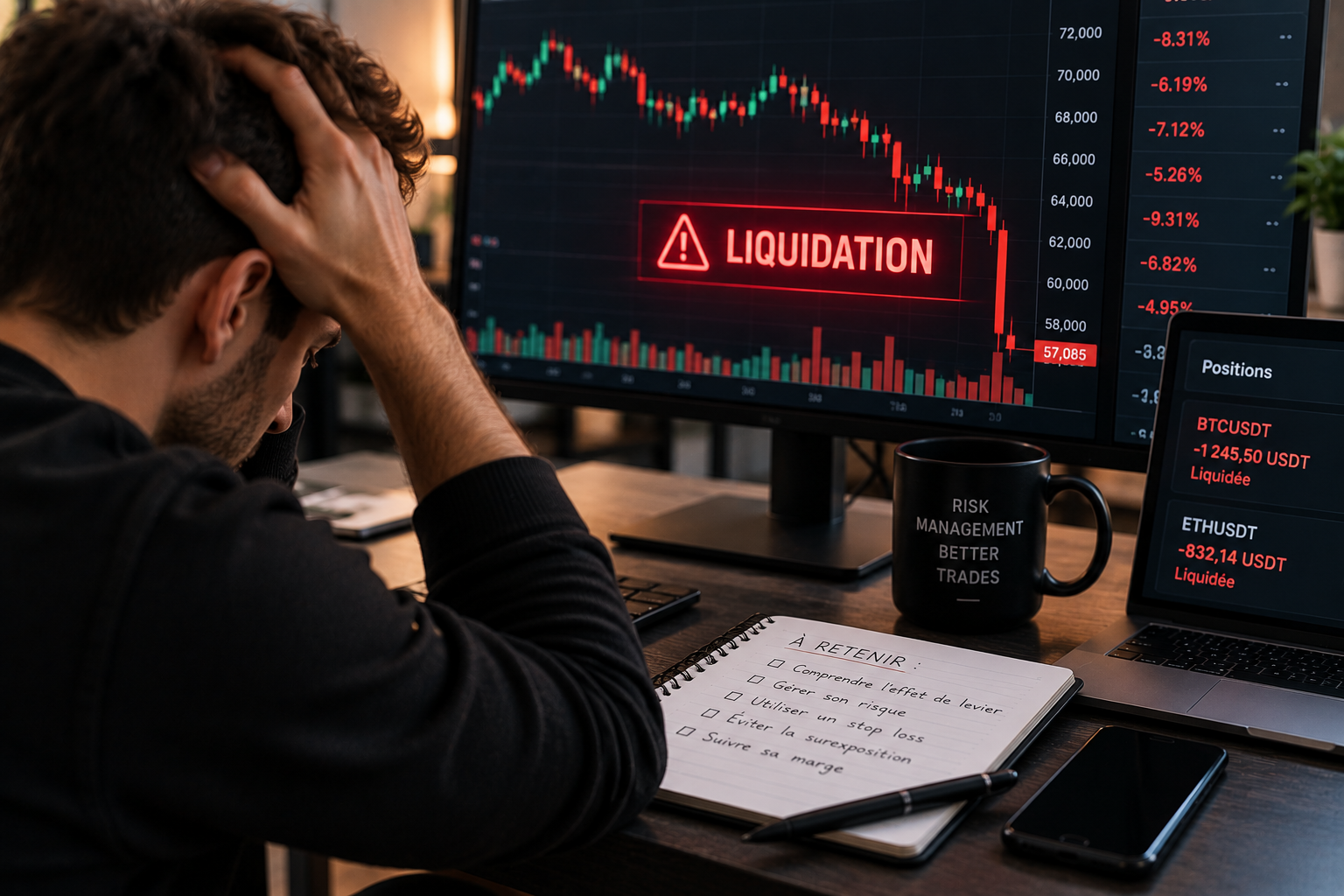
It’s the nightmare of every trader who uses leverage: watching your position close automatically, with a dead loss of your entire stake. This mechanism has a name, liquidation, and it wipes out whole accounts in a matter of seconds on the crypto market. Yet there’s nothing mysterious about it: properly understood, liquidation can largely be avoided. In this guide, we explain what liquidation is, how it’s triggered, why it traps so many beginners, and above all how to protect yourself from it.
What is liquidation?
Liquidation is the automatic, forced closing of your position by the platform when your losses reach the amount of margin you committed. In plain terms: the platform forcibly closes your trade to prevent you from losing more than your initial stake.
This mechanism only exists in leverage trading, meaning when you borrow funds from the platform to open a position larger than your capital. In spot trading, without leverage, liquidation doesn’t exist: you can take a loss, but you’ll never see your position closed by force.
How is a liquidation triggered?
To understand it, let’s take the principle of leverage. With 10x leverage, you control a $10,000 position with just $1,000 in margin. Every price move is amplified ten times relative to your actual capital.
The flip side is brutal. If the price moves 10% in the wrong direction, your loss reaches 100% of your margin: the platform liquidates you. The higher the leverage, the smaller the move needed to liquidate you. Here’s the mechanical effect:
- 2x leverage: an adverse move of around 50% triggers liquidation
- 10x leverage: an adverse move of around 10% is enough
- 50x leverage: an adverse move of around 2% is enough
- 100x leverage: an adverse move of around 1% is enough
The price at which this blade falls is called the liquidation price. The platform calculates it and displays it when you open the position. It’s a vital piece of information to check before validating a trade.
Why liquidation traps so many beginners
On the crypto market, liquidation wreaks havoc for one simple reason: volatility. Cryptocurrencies can move several percent in a few minutes, sometimes in a few seconds during a spike. A trader using high leverage therefore ends up with a liquidation price very close to their entry price.
The result: a simple market jolt, a perfectly normal noise move, is enough to liquidate them, even though their underlying direction may have been correct. Many beginners, drawn by the promise of multiplied gains, open positions at 50x or 100x leverage without realizing that a micro-move wipes them out. High leverage isn’t a gain accelerator for beginners, it’s a liquidation machine.
Sharp moves and wicks (those very fast price spikes) are particularly dangerous: they can touch your liquidation price for an instant, close your position, then the price comes back. You’re liquidated, and the market moves on without you.
How to avoid liquidation
The good news is that liquidation can be avoided with method. Here are the levers, from the most important to the most refined.
1. Reduce leverage (or go without it)
This is protection number one. The lower your leverage, the further away your liquidation price, and the more room you have to absorb normal market moves. For a beginner, spot trading without leverage remains by far the wisest approach. If you use leverage, stick to very low multiples (2x, 3x), never the 50x or 100x that look appealing on paper.
2. Always place a stop loss
A stop loss closes your position at a loss level you’ve chosen, BEFORE the liquidation price is reached. This is fundamental: you take back control of your exit instead of suffering it. A leveraged trade without a stop loss is reckless risk-taking. The stop loss must be planned from the moment you open the position, never after.
3. Calibrate your stop on real volatility
Setting a stop too tight means getting knocked out by normal market noise. Too wide, and you risk big. The ideal is to calibrate the stop distance on the asset’s real volatility, using an indicator like the ATR (Average True Range). It measures the average range of moves and helps place a stop that lets the trade breathe while protecting your capital.
4. Size your position properly
Never commit more margin than your risk tolerance allows. A common rule is to risk only a small percentage of your total capital per trade. That way, even a liquidation never jeopardizes the whole account.
Liquidation and scalping: heightened vigilance
Traders who practice scalping (many very short positions) often use leverage to amplify tiny price moves. This is precisely the profile most exposed to liquidation. For them, discipline on the stop loss and position sizing isn’t an option, it’s a condition for survival.
How SumoAnalysis helps avoid liquidations
Most liquidations come from two mistakes: poorly managed leverage and a badly placed (or missing) stop loss. That’s exactly where SumoAnalysis brings discipline.
Each crypto signal comes with a complete plan: entry, stop loss and targets. The stop isn’t arbitrary: TP/SL optimization calibrates it on real volatility via the ATR, which helps avoid liquidations triggered by market noise. AI-powered technical analysis and multi-timeframe trading filter out fragile setups, the ones that most often lead to liquidation. You keep control of your leverage, but you trade with a solid plan rather than blindly.
Summary
- Liquidation is the forced closing of your position when your losses reach your margin
- It only exists with leverage, never in spot trading
- The higher the leverage, the smaller the move needed to liquidate you
- Crypto volatility makes high leverage particularly dangerous for beginners
- To avoid it: reduce leverage, always place a stop loss, calibrate it on the ATR, size your position properly
- Spot trading without leverage remains the wisest approach to start with
👉 Try SumoAnalysis free for 7 days and trade with stops calibrated on real volatility, to limit the risk of liquidation.
Disclaimer: This article is for educational purposes and does not constitute investment advice. Cryptocurrency trading carries a risk of capital loss. Only trade with capital you can afford to lose.