


<!– META TITLE: How to protect yourself from crypto scams: the complete guide –>
<!– META DESCRIPTION: Pump and dump, fake projects, phishing, fake support: discover the most common crypto scams and the concrete habits to protect your funds. –>
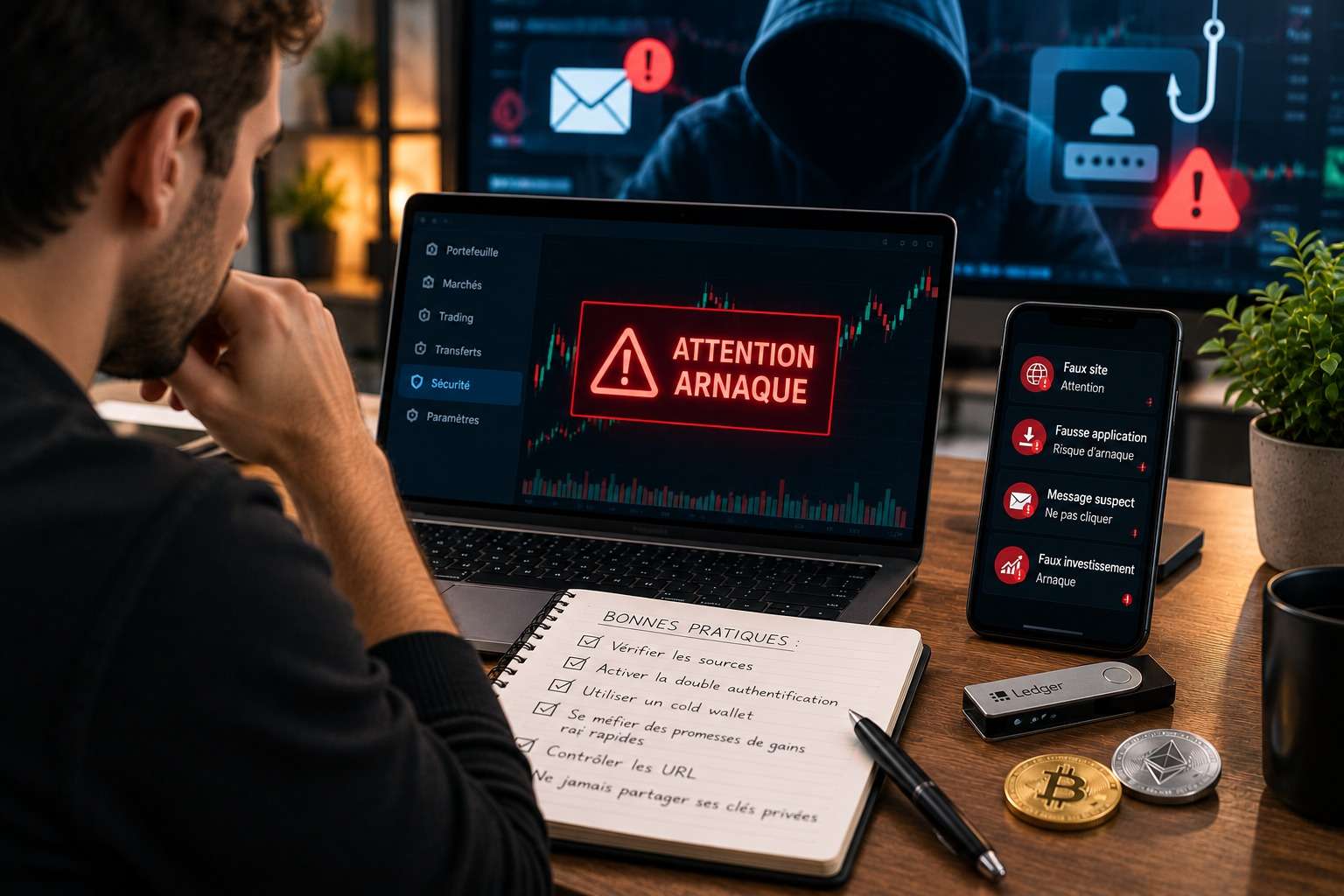
<p>The crypto market attracts serious investors and scammers alike. Young, global, partly unregulated and full of promises of quick gains, it’s an ideal playground for scams. The good news: the vast majority of them rely on a few recurring mechanics. Knowing them means already knowing how to spot them. In this guide, we review the most common crypto scams and the concrete habits to protect your funds.</p>
<h2>The pump and dump</h2>
<p>This is one of the most widespread scams. The <a href=”https://www.sumoanalysis.com/glossary/crypto-pump-and-dump/”>pump and dump</a> consists of artificially inflating the price of a small cryptocurrency (the pump), through massive, coordinated promotion, to attract buyers. Once the price has soared, the organizers sell everything at once (the dump), pocket the gains, and the price collapses, leaving the last buyers with heavy losses.</p>
<p>The typical warning sign: an unknown crypto whose price suddenly explodes, accompanied by intense promotion on social media and promises of guaranteed gains. If everyone is pushing you to buy quickly before you “miss the train”, be wary: it’s often the trap closing in.</p>
<h2>Fake projects and rug pulls</h2>
<p>A rug pull refers to a crypto project built from scratch to disappear with investors’ money. The creators set up an attractive project (polished website, promises of returns, active community), raise funds, then vanish overnight with the cash.</p>
<p>The warning signs are often the same: an anonymous or unverifiable team, promises of unrealistic returns, a vague or copied white paper, constant pressure to invest fast. A legitimate project doesn’t need to rush you or guarantee gains.</p>
<h2>Phishing and key theft</h2>
<p>Phishing aims to make you reveal your sensitive information: login credentials, private key, or above all your recovery phrase (seed phrase). The methods vary: fake emails imitating your platform, fake websites whose address resembles the original, fake forms, booby-trapped links.</p>
<p>The absolute rule: NEVER share your private key or your recovery phrase with anyone, under any pretext. No platform, no legitimate support will ever ask for them. To understand everything about these keys and their role, see our guide on the <a href=”https://www.sumoanalysis.com/glossary/what-is-a-crypto-wallet/”>crypto wallet</a>. Always check the exact address of websites, and be wary of links received by message.</p>
<h2>Fake support and fake accounts</h2>
<p>Very common, this scam involves impersonating a platform’s technical support or a well-known crypto personality. The scammer contacts you (or gets you to reach out via fake accounts), earns your trust, then asks for your information or urges you to send funds “to unlock a problem” or “double your stake”.</p>
<p>Remember: real support never contacts you first by private message, never asks for your credentials, and never promises to multiply your money. Any crypto “gift” offer where you first have to send funds is a scam, without exception.</p>
<h2>Exploiting your emotions: FOMO and FUD</h2>
<p>Most scams don’t hack your computer, they hack your emotions. Two levers come up systematically.</p>
<p><a href=”https://www.sumoanalysis.com/glossary/what-does-fomo-mean-crypto/”>FOMO</a> (the fear of missing out) pushes you to act fast, without thinking, for fear of missing a gain. It’s the engine of pump and dumps and fake giveaways. Conversely, <a href=”https://www.sumoanalysis.com/glossary/crypto-fud/”>FUD</a> (fear, uncertainty, doubt) can be weaponized to make you panic and take bad decisions. A scammer almost always tries to short-circuit your thinking through urgency or fear. The moment you feel that pressure, it’s time to slow down.</p>
<h2>The 7 anti-scam habits</h2>
<p>Here are the habits to adopt systematically to protect your funds:</p>
<ul>
<li>Never share your private key or recovery phrase, with anyone</li>
<li>Be wary of any promise of guaranteed gains or unrealistic returns</li>
<li>Always check the exact address of websites before logging in</li>
<li>Real support never contacts you first and never asks for your credentials</li>
<li>Resist urgency: pressure to “act fast” is a major warning sign</li>
<li>Research a project before investing (team, track record, transparency)</li>
<li>Secure your funds on a wallet whose keys you hold</li>
</ul>
<p>One principle sums it all up: if it seems too good to be true, it is. Caution is never a waste of time in crypto.</p>
<h2>Trade with reliable tools rather than promises</h2>
<p>Many scams thrive on the fantasy of easy, guaranteed gains. A serious player, by contrast, will never promise you assured profits, because they don’t exist. Real trading rests on method, rigorous analysis and risk management, not on miracle promises.</p>
<p>That’s the philosophy of SumoAnalysis. AI-powered <a href=”https://www.sumoanalysis.com/ai-powered-analysis/”>crypto technical analysis</a> provides an objective read of the market, each <a href=”https://www.sumoanalysis.com/crypto-signal/”>crypto signal</a> comes with a complete, transparent plan (entry, stop, targets) with clear <a href=”https://www.sumoanalysis.com/tp-sl-optimization/”>risk management</a>. No guaranteed gains, no artificial urgency: just tools to decide for yourself, with full awareness.</p>
<h2>Summary</h2>
<ul>
<li>The pump and dump artificially inflates a price before an organized collapse</li>
<li>Rug pulls are fake projects created to disappear with the funds</li>
<li>Phishing tries to steal your keys: never share them</li>
<li>Fake support never contacts you first and never promises to multiply your money</li>
<li>Scams exploit FOMO and FUD: urgency and fear are warning signs</li>
<li>If it seems too good to be true, it’s a scam</li>
</ul>
<p>👉 <a href=”https://www.sumoanalysis.com/contact-us/”>Try SumoAnalysis free for 7 days</a> and trade with transparent tools, without miracle promises.</p>
<hr>
<p><em>Disclaimer: This article is for educational purposes and does not constitute investment advice. Cryptocurrency trading carries a risk of capital loss. Only trade with capital you can afford to lose.</em></p>