


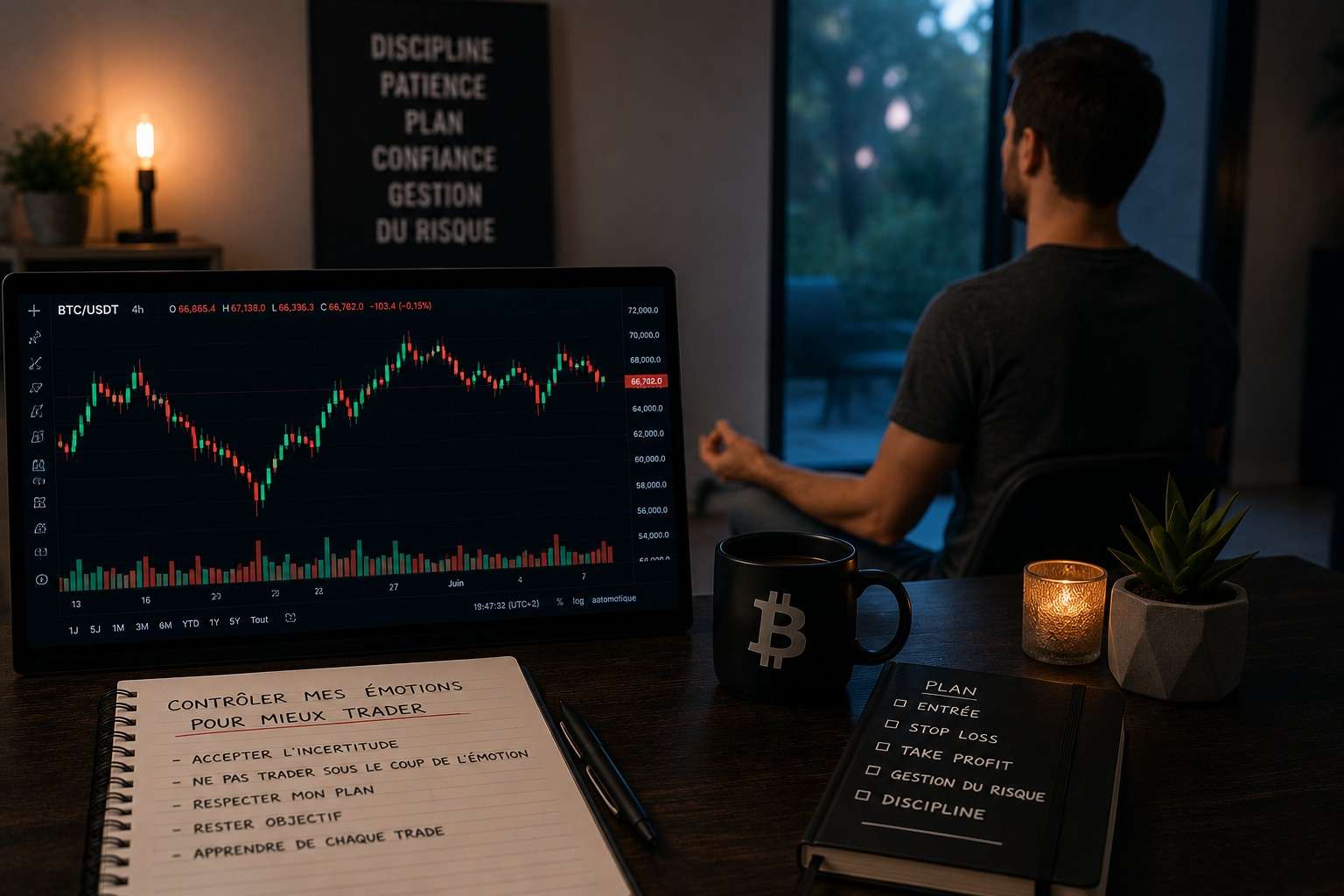
perfectly well: they know what they should do, but they can’t do it at the decisive moment. The reason is almost always the same, emotions. Fear, greed and impatience push us to act against what reason dictates. Learning to manage your emotions isn’t an extra, it’s the core of the trader’s job.
In this guide, we review the main emotions that sabotage traders and the concrete methods to master them.
Why emotions are the trader’s number one enemy
Trading activates powerful psychological mechanisms. When real money is at stake, our brain reacts with reflexes inherited from survival: flee danger, seize an opportunity, avoid the pain of a loss. These reflexes, useful in daily life, are catastrophic in trading.
Concretely, emotion pushes us to sell at the worst moment out of fear, to buy at the top out of greed, or to cling to a losing position out of denial. The market, on the other hand, feels nothing. The trader who lets emotions decide puts themselves in a position of weakness against a perfectly indifferent market. Emotional mastery is therefore what separates profitable traders from the rest.
Fear: selling too early, not daring
Fear shows up in several ways. It pushes us to exit a winning position too early, afraid of watching the gain disappear. It prevents us from taking a good trade out of fear of losing. It causes panic selling when the market drops, often just before a rebound.
To master fear, the key is to have a plan defined in advance. When your entry and exit rules are set calmly, before the action, you no longer have to decide under the grip of emotion: you execute your plan. A stop loss and a target defined in advance turn an anxiety-inducing decision into the simple application of rules.
Greed: always wanting more
Greed is the mirror of fear. It pushes us to hold a winning position too long, hoping for even more, until the move reverses and erases the gains. It encourages us to increase positions beyond reason, or to multiply trades to gain faster.
The antidote to greed is planned profit-taking. By defining your targets in advance and securing your gains in stages, you strip greed of its decision-making power. A tiered take profit, for example, lets you secure part of the gain while letting the rest run, a good compromise between discipline and potential.
FOMO: the fear of missing out
FOMO (Fear Of Missing Out) deserves a special mention given how much damage it causes. It’s that sense of urgency that grips you when a crypto soars and you’re afraid of missing the chance. Under its influence, you buy in a hurry, without analysis, often at the top, just before the correction.
To fight FOMO, remember a simple truth: there will always be other opportunities. The crypto market never sleeps and constantly generates setups. Missing a move isn’t serious, entering a bad trade out of haste is far worse. If you feel the urge to buy out of fear of missing out, treat it as a warning signal rather than an opportunity.
Denial and hope: clinging to a losing position
This may be the most costly emotion. When a trade goes wrong, it’s tempting to refuse reality and hope for a reversal. You move your stop loss to “give the trade a chance”, you tell yourself stories, you wait. The result: a small planned loss turns into a catastrophic one.
The solution is to accept that losses are part of the game. No trader wins every time, and a planned loss isn’t a failure: it’s a normal cost of the activity. Respecting your stop loss means accepting a small controlled loss to protect your capital. You never move a stop to avoid the pain of a loss.
Concrete methods to stay in control
Beyond understanding, a few practical habits help discipline your emotions day to day.
Keep a trading journal. Recording each trade, with the reason for entry and your emotional state at the time, helps you spot recurring patterns and improve. Many traders discover this way that their worst decisions are always made in the same emotional states.
Define all your rules in advance. Entry, stop loss, targets, position size: the more you decide calmly, the less room you leave for emotion in the heat of the action.
Set yourself limits. A maximum loss per day or per week, beyond which you stop trading, avoids the emotional spirals where you try to “win it back”.
Step back. Taking breaks, moving away from the screen, not trading when you’re tired or upset: clarity is a limited resource that must be preserved.
Objective analysis, a safeguard against emotion
The most effective way to reduce the influence of emotions is to rely on objective analysis rather than your feelings. This is precisely what SumoAnalysis offers. The AI-powered crypto technical analysis evaluates the market without fear or greed, based solely on data and market structure.
Each crypto signal provides a structured plan with entry, stop and targets defined in advance, which helps you execute rules rather than react to the emotion of the moment. TP/SL optimization plans your exits to counter fear and greed, and multi-timeframe analysis filters out impulsive trades by requiring consistency across several timeframes. The tool doesn’t remove your emotions, but it gives you an objective framework so you don’t let them decide for you.
Summary
- Emotions, not lack of knowledge, are the leading cause of trader failure
- Fear pushes you to sell too early and not dare: a plan defined in advance fixes this
- Greed pushes you to always want more: planned profit-taking is the antidote
- FOMO pushes you to buy in a hurry: remember there will always be other opportunities
- Denial pushes you to cling to losing positions: accepting losses is part of the game
- Concrete methods: trading journal, rules defined in advance, loss limits, stepping