


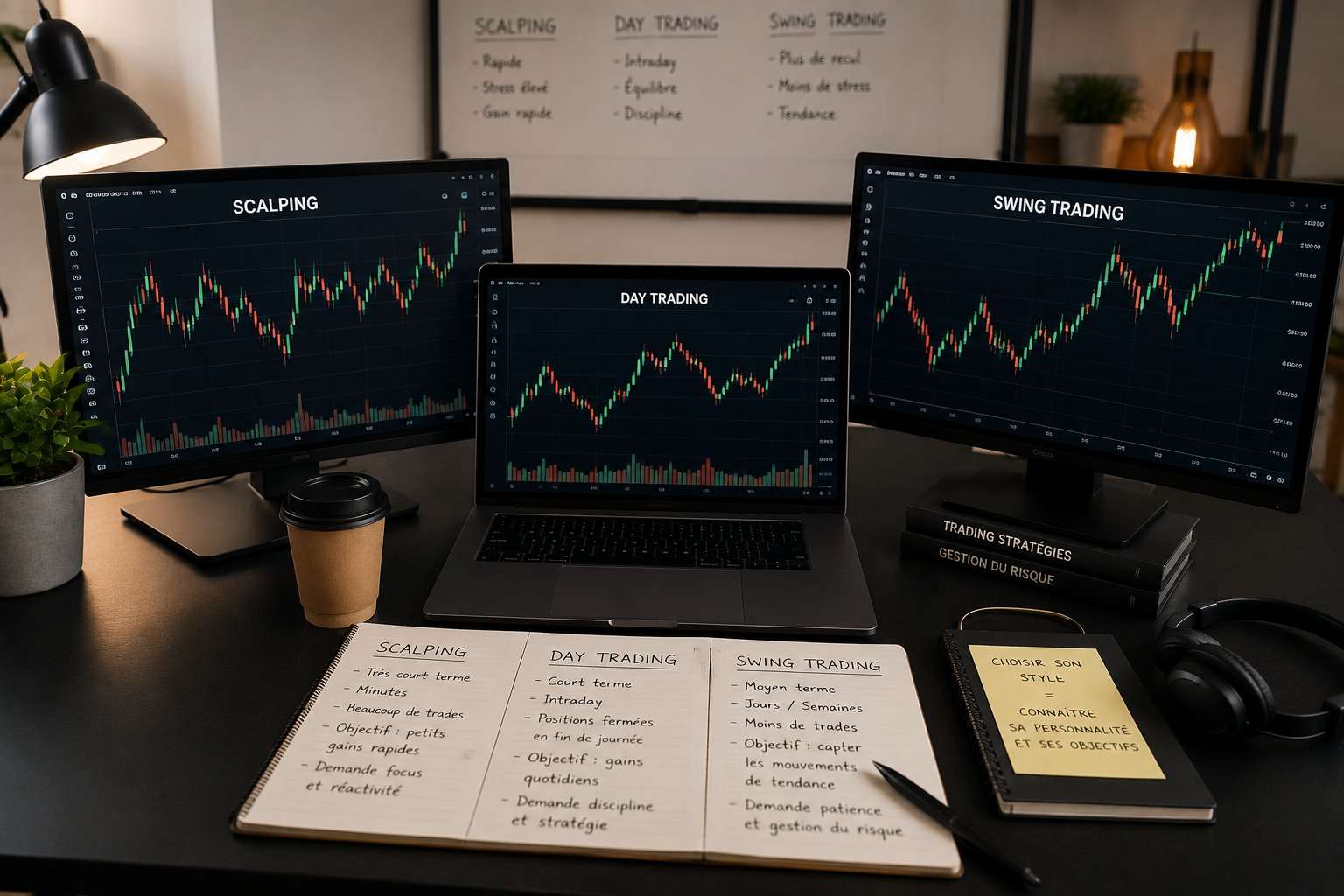
There isn’t just one “right” style of crypto trading, but rather several approaches that suit different profiles, schedules, and temperaments. Many beginners fail not because they’re bad at it, but because they try to trade in a style that doesn’t suit them: a family man trying to scalp between meetings, or an enthusiast who’s available all day but gets bored with swing trading. Choosing the right style is a foundational decision that’s often overlooked.
In this guide, we compare the three major trading styles (scalping, day trading, and swing trading) to help you find the one that suits you best.
Scalping: Speed Above All
Scalping involves making numerous very short trades—lasting from a few seconds to a few minutes—to capture small price movements. A scalper opens and closes dozens of positions per day, aiming each time for a modest but quick profit.
This style is practiced on short time frames, primarily 5-minute and 15-minute charts. It requires total focus and immediate responsiveness: the scalper is glued to their screen during trading sessions, with no room for distractions.
Who is it for?
Scalping is suitable for people who are available, able to stay focused for long periods, enjoy the action, and make quick decisions without stress. It requires discipline and good emotional control, as the intense pace can quickly lead to mistakes. It is the most demanding style and is generally not recommended for complete beginners.
Day Trading: All Within the Same Day
Day trading involves opening and closing positions within the same day, without ever holding a position overnight. Trades last from a few minutes to a few hours, and the day trader closes everything out before the end of the trading session.
This style is primarily practiced on intermediate time frames, such as 15-minute, 1-hour, and 4-hour charts. It is less frenetic than scalping but still requires regular attention to monitor positions and seize opportunities.
Who is it for?
Day trading is suitable for people who can devote several hours a day to the market on a regular basis. It offers a good balance between responsiveness and reflection: less stressful than scalping, but more dynamic than swing trading. The psychological advantage is not keeping any positions open overnight, which avoids the stress of waking up to an unpleasant surprise.
Swing Trading: Patience Pays Off
Swing trading involves capturing price movements that last from several days to several weeks. The swing trader opens a position and holds it while the trend develops, without needing to monitor the market constantly.
This style is practiced on longer time frames, primarily the 4-hour and 1-day charts. It’s the least time-consuming approach: a few checks per day are sufficient, often in the morning and evening.
Who is it for?
Swing trading is ideal for those with full-time jobs or limited time to devote to the market. It requires patience and the ability to withstand price fluctuations without reacting impulsively. It’s generally the best style for beginners, as it allows time to think before acting and generates fewer false signals than shorter time frames.
How to Choose Your Style?
The right style depends on three main factors, which you should assess honestly.
The first is your availability. How much time can you realistically devote to trading each day? If you have a demanding job, swing trading is the natural choice. If you have several hours available, day trading becomes a viable option. Scalping requires near-constant availability during trading sessions.
The second factor is your temperament. Do you like fast-paced action, or do you prefer calm, measured reflection? Do you handle stress well, or do you need time to make decisions? A calm and patient temperament thrives in swing trading, while a lively and reactive temperament prefers shorter time frames.
The third factor is your experience. Beginners are best off starting with swing trading, which is more forgiving of mistakes and less stressful. You can always move on to shorter time frames as you progress and gain more mastery.
One thing all styles have in common: risk management
Regardless of the style you choose, one principle remains the same: risk management. Whether you’re scalping on a 5-minute timeframe or holding a swing position for several weeks, you must always set a stop-loss, calculate your position size, and aim for a good risk-reward ratio. The style changes the pace, not the fundamentals.
What does change, however, is the calibration. A stop-loss in scalping will be much tighter than one in swing trading, since volatility varies depending on the time frame. This is exactly what SumoAnalysis’s TP/SL optimization handles, automatically adjusting the levels to the volatility of each time frame.
SumoAnalysis adapts to your style
One of SumoAnalysis’s strengths is that it covers all trading styles. Thanks to multi-timeframe analysis, the software generates signals across five timeframes, ranging from 5 minutes for scalpers to 1 day for swing traders. You simply filter the signals according to the style that suits you best.
Each crypto signal indicates its original timeframe and provides a comprehensive plan tailored to that timeframe, including entry, stop-loss, and profit targets. And the AI-powered crypto technical analysis verifies consistency across timeframes, which is useful regardless of your trading style. Whether you’re a scalper, day trader, or swing trader, the tool adapts to your pace rather than the other way around.
In summary
- Scalping: trades lasting from a few seconds to minutes, on 5-minute and 15-minute timeframes, for those who are highly available and responsive
- Day trading: positions closed within the same day, on 15-minute to 4-hour timeframes, for those who have several hours per day
- Swing trading: movements spanning several days to weeks, on 4-hour and 1-day timeframes, ideal for busy schedules and beginners
- Three factors to consider when choosing: your availability, your temperament, and your experience
- Beginners are advised to start with swing trading, which is more forgiving and less stressful
- Regardless of the style, risk management remains the common foundation
👉 Try SumoAnalysis free for 7 days and receive signals tailored to your trading style, from scalping to swing trading.
Disclaimer: This article is for educational purposes only and does not constitute investment advice. Cryptocurrency trading involves the risk of capital loss. Only trade with capital you can afford to lose.