


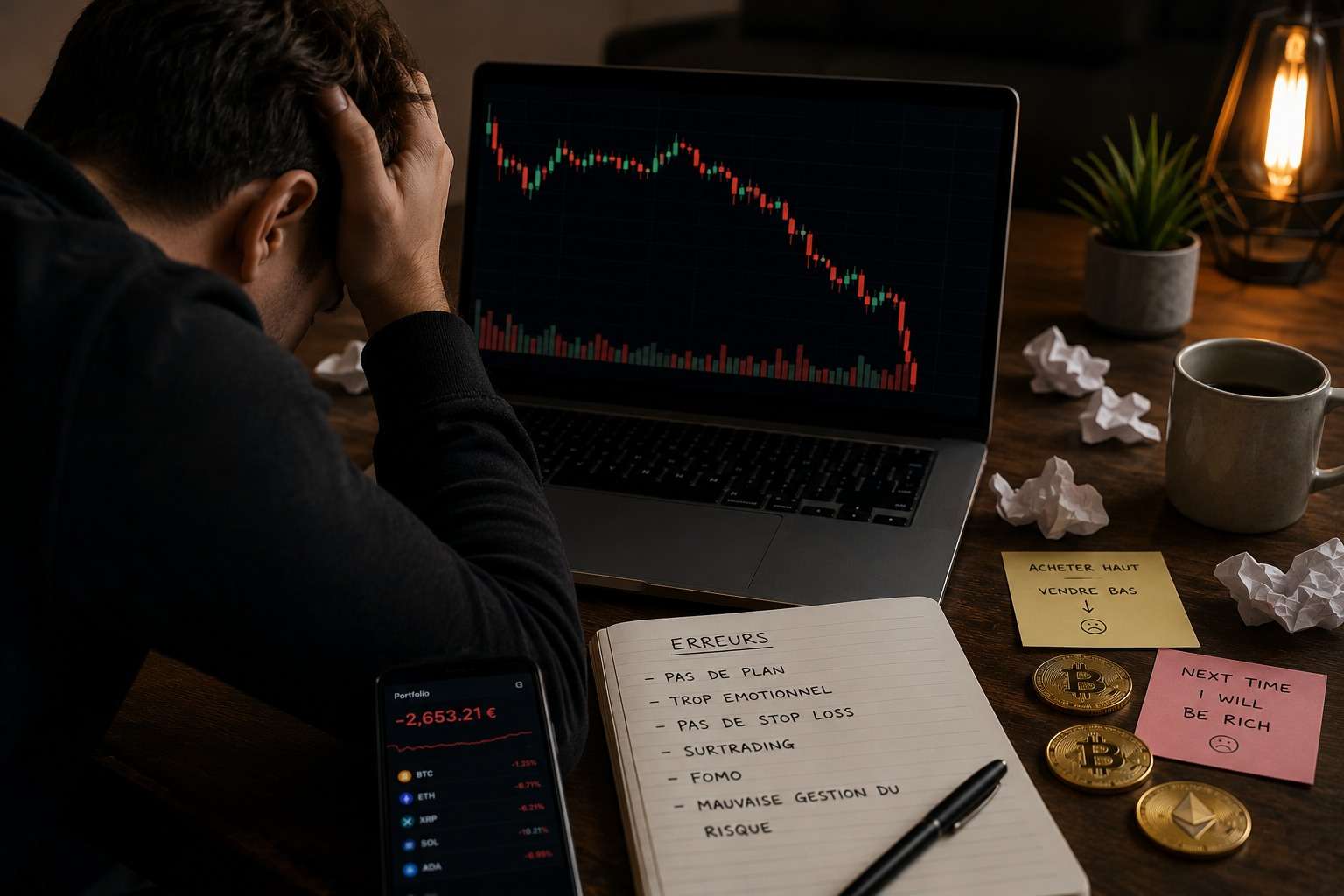
Most beginners who get into crypto trading don’t lose because of bad luck or a complicated flawed strategy. They lose because of a handful of classic mistakes, repeated over and over, that almost everyone makes at the start. The good news is that these mistakes are perfectly well known and avoidable. Identifying them in advance already puts you ahead of the majority of new traders.
Here are the most common mistakes made by crypto beginners, and above all how to avoid them.
Mistake #1: trading without a stop loss
This is the most dangerous mistake of all. Many beginners open a position without defining in advance where they’ll exit in case of a loss. The result: when the market moves against them, they hope for a reversal, refuse to sell, and watch a small loss turn into a disaster.
The stop loss is a non-negotiable protection. It defines your maximum loss before you even enter, while you’re still clear-headed. On a market as volatile as crypto, open 24/7, trading without a stop loss is like driving without a seatbelt. The rule is simple: no position without a stop loss defined in advance.
Mistake #2: using too much leverage
Leverage lets you trade with more money than you own, multiplying potential gains. But it multiplies losses in exactly the same way. Lured by the promise of quick profits, many beginners use high leverage and get liquidated on the first unfavorable move.
With high leverage, a small price move in the wrong direction is enough to wipe out your entire position. To start, the wisest approach is to trade without leverage, or with very low leverage. The priority isn’t to maximize gains, but to survive long enough to learn.
Mistake #3: risking too much on a single trade
Betting a large portion of your capital on a single position is a common mistake, often driven by the conviction of having found the “sure” trade. The problem is that no trade is sure. A losing streak is statistically inevitable, and if each loss heavily cuts into your capital, you’ll be ruined before you even have time to improve.
The professional traders’ rule is to never risk more than 1 to 2% of your capital per trade. To apply this rule, you need to know how to calculate your position size from your stop loss. It’s a fundamental reflex that protects your capital over time.
Mistake #4: giving in to FOMO
FOMO (Fear Of Missing Out) is the number one emotional trap. You see a crypto soaring, you’re afraid of missing the train, so you buy in a hurry, often at the top. Then the price corrects, and you find yourself at a loss.
Buying on impulse, without a plan or analysis, is a recipe for losing. The best opportunities aren’t the ones everyone rushes for in euphoria, but the ones you identified coldly in advance. If you feel the urge to buy out of fear of missing out, it’s often a sign to hold back.
Mistake #5: overtrading
Many beginners think you have to trade constantly to make money. They multiply positions, take low-quality trades just to “do something”, and pile up fees and mistakes. This is overtrading.
In reality, good trading often means patiently waiting for the rare high-probability setups, and doing nothing the rest of the time. Quality over quantity. A disciplined trader who takes three good trades a week largely outperforms one who takes twenty mediocre ones.
Mistake #6: having no trading plan
Trading on feeling, without defined rules, is another recurring mistake. Without a plan, every decision is made under the emotion of the moment, which leads to inconsistency and repeated errors.
A trading plan defines your entry criteria, your exit rules, your risk management and the markets you follow, all in advance. It turns trading from an emotional gamble into a disciplined process. Even a simple written plan is infinitely better than no plan at all.
Mistake #7: moving your stop loss
Here’s an insidious mistake. A beginner correctly places their stop loss, but when the price approaches it, they move it to “give the trade more room”, hoping for a reversal. This is one of the most destructive habits there is.
Moving your stop in the unfavorable direction means removing your protection at the worst possible moment. The stop was placed for a reason, based on analysis done calmly. Respecting it means accepting a small planned loss rather than risking a large uncontrolled one. You never move a stop loss to avoid being stopped out.
The common thread of all these mistakes
If you look at these seven mistakes, a common thread appears: they almost all come from emotion and lack of discipline. Fear, greed, impatience and hope are the trader’s real enemies, far more than the market itself.
This is precisely where an objective analysis tool makes the difference. SumoAnalysis was designed to remove emotion from the equation. The AI-powered crypto technical analysis evaluates the market without fear or greed, and each crypto signal provides a structured plan with entry, stop loss and targets. This helps you avoid FOMO, respect your stops and only take quality trades.
TP/SL optimization automatically calibrates your risk levels, and multi-timeframe analysis filters out low-quality trades by checking consistency across several timeframes. So many safeguards against the classic beginner mistakes.
Summary
- Mistake #1: trading without a stop loss, the most dangerous of all
- Mistake #2: using too much leverage and risking liquidation
- Mistake #3: risking too large a share of your capital on a single trade
- Mistake #4: giving in to FOMO and buying on impulse
- Mistake #5: overtrading, favoring quantity over quality
- Mistake #6: trading without a plan defined in advance
- Mistake #7: moving your stop loss to avoid being stopped out
- The common thread: emotion and lack of discipline, the beginner’s real enemies
👉 Try SumoAnalysis free for 7 days and avoid the classic mistakes with structured signals that remove emotion from your decisions.
Disclaimer: This article is for educational purposes and does not constitute investment advice. Cryptocurrency trading carries a risk of capital loss. Only trade with capital you can afford to lose.